Beauty Marks
“That first timeness—the world starts in this picture.” Fairfield Porter said this of his paintings in 1968. The phrase names not a style but a condition of perception: an immediacy in which the world appears freshly, without precedent, as if painting itself were discovering its object for the first time.
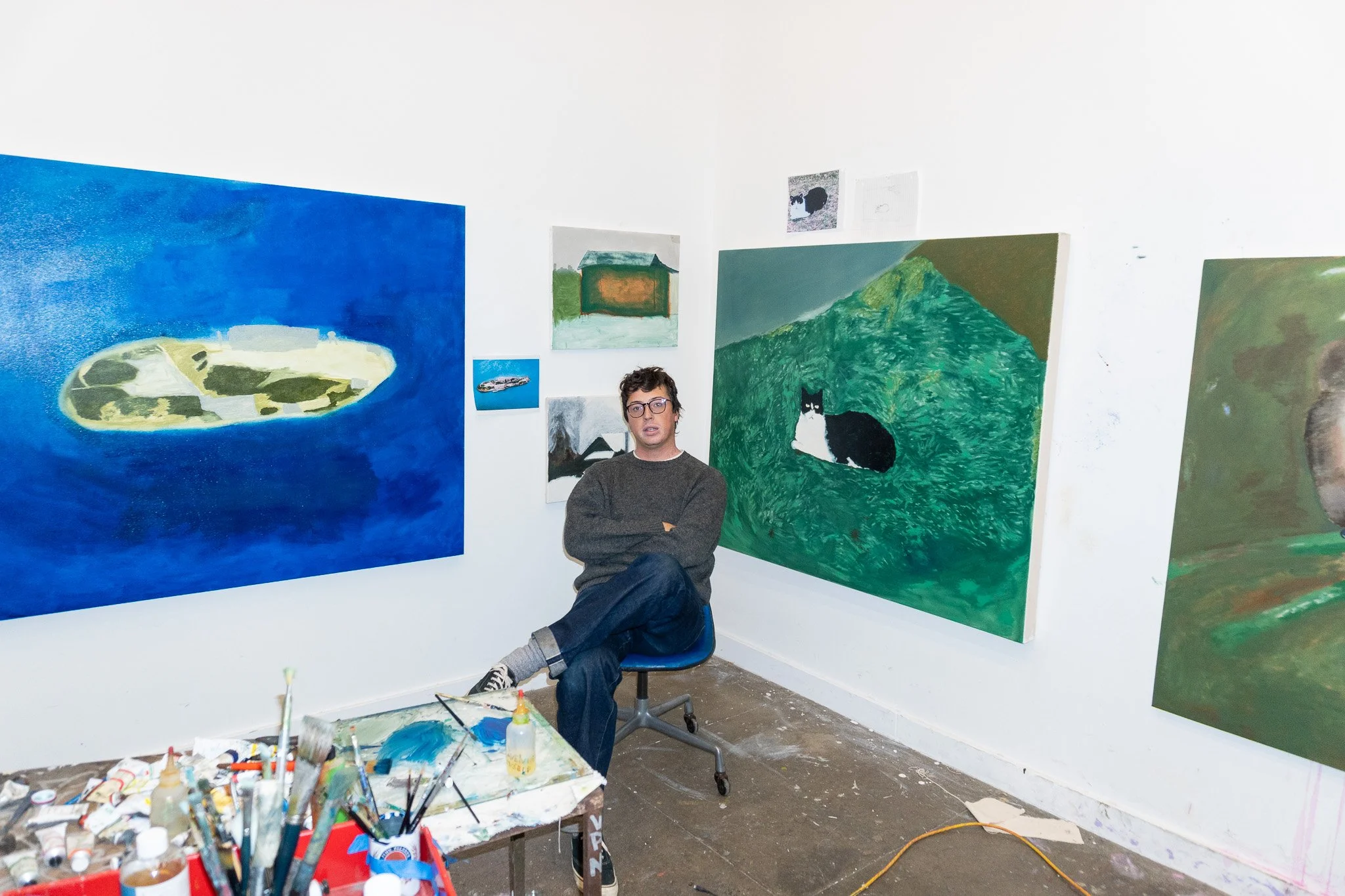
The same can be said of Arthur’s paintings. His flat renderings of animals, exteriors of buildings, and other surfaces exposed to light might best be described as primary. Arthur’s subjects are always singular and literal, perennial and quaint, but not nostalgic, almost resembling the perception of a child. The paintings make no claim to verisimilitude, or to hide the method of their construction. The outlines of the subjects fail to cohere, but their dissonance is placated by the sentimentality of their color. The brushstrokes are all legible with a sort of honest pride in having been brushed. There is a shameless modesty in their aim, what one might call the originary task of art: the depiction and transmission of beauty.
There is a word that encapsulates this position, particularly at a moment when beauty in art is often greeted with suspicion, derision, or guilt. It is a word many artists go out of their way to avoid being associated with, but one Arthur seems to invite, even seek out. That word is twee.
Twee is more often used to dismiss than to describe. It is commonly taken to signify childishness, decoration, or retreat—a minor aesthetic confused with incapacity. Its smallness is read as shame, its softness as political evasion. In contemporary discourse, twee is frequently folded into critiques of neoliberal taste culture, where intimacy and craft are reduced to shibboleths of an endangered class of urban faux-bohemians.
Those criticisms are earned, but their targets are not truly twee. What twee designates is not an aesthetic, but a formal, historically contingent method. It emerges at a postwar moment wherein the goal of beauty and pleasure in art is viewed as naive or irresponsible, and internalizes this naivety in its very structure. Its major tenets, as described by Marc Spitz are as follows: “beauty over ugliness; a sharp, almost incapacitating awareness of darkness, death, and cruelty; a tether to childhood and its lack of innocence.” It begins with beauty, but necessarily fails to cohere into representation (hence we see the polished gentrifier twee as a version of kitsch). It is not, however, a defeatist practice. The very existence of the work becomes a register of youthful optimism, frankly displaying the evidence of its creation.
Calvin Johnson’s Beat Happening is commonly understood as the twee act par excellence, a band once described as “three eight-year-olds with a guitar, some pots and pans, and a boombox, singing songs about holding hands and going swimming.” What is twee however is not the content of the music—the cloying lyrics about picking apples or the doodle of a cat on the album cover—but the way its sentimental subject is held against a dissonance that remains irreducible to its expression. Dissonance in twee comes in many forms, but most commonly emerges out of imperfections in the medium of itself. What is referred to as “lo-fi” is not a regressive fetishization of the ignorance of youth or a form of self-sabotage, but an acknowledgement that by entering into the world, the intention of beauty must face ugliness. This encounter explodes expression without eliding the underlying sentiment. Cruelty remains heterogeneous to the impulse; it is not resolved within the work’s content.
By adopting a position of nascency, the twee artist formally stages a confrontation with a darkness that would otherwise nullify the artwork. For Arthur, this is most legible in Island, a painting that began as a perception of Alcatraz and has since transformed into a rendering of its own becoming. In a certain sense, the painting was Alcatraz, yet it remains unclear whether it knows its biography, or even what Alcatraz is at all. This is not an erasure of history, but a condition of the work’s primariness: its capacity to exist at all depends on not assimilating its object into knowledge. Realism would collapse into kitsch, while self-consciousness would wallow in cynicism. It is through this literal, childlike mode of perception—in which the fact of Alcatraz remains external to representation—that the world becomes newly, and paradoxically, available.
This formal reading of twee runs counter not only to its understanding in popular culture, but also to the dominant structural interpretation of cuteness in postwar art, as articulated by Sianne Ngai. Building upon Adorno’s claims on the barbarism of pursuing art in a broken world, she reads cuteness “an aesthetic of ineffectuality.” It is as if art is cowering, transforming itself into something non-threatening to compensate for the guilt of seeking pleasure or its inability to represent the totality of our world. While Ngai identifies a certain critical potential in this ineffectualness, such a reading damns art to a perpetual culpability for a world it merely inherited. It ignores how assuming a minor position would allow art to retain its original goal.
Twee understands that the real root of shame is not creation, but reification. An early twee compilation titled Why Popstars Can’t Dance expresses this truth bluntly: “because guilty feet have got no rhythm.” Even Beat Happening’s unfinished sound partly functioned as a marketing stunt to encourage bands to form under Johnson’s “K Records,” an independent label that pioneered cassettes as a format. Twee resolves what for Adorno is both “art’s vital element and greatest source of shame...the contradiction between the made and the apparent not-having-become.” The more art disguises the traces of its making through perfection, the more it becomes indistinguishable from the production of mass goods, which only aspire to beauty as a form of escapism. “True works of art,” Adorno writes in Minima Moralia, “are those which push this contradiction to the extreme, and realize themselves in their resultant downfall.”
Arthur works in the spirit of a lineage of painters for whom beauty and modesty operate in tandem, who eschew representation for immediacy, whose paintings make no attempt to elide their status as paintings—among them Fairfield Porter, Milton Avery, and Philip Guston. It is a lineage that Porter himself traced back to the French, recalling Bonnard’s account of Renoir’s injunction to “make everything more beautiful.” Even the pessimist Adorno understood what was radical in the French tradition’s “pride in making little pictures…[that] sublime artistry keeps a hold on sensuous life by a moment of harmless pleasure in the bien fait.” And while Arthur shares these values, these are not little canvases. They proudly charm us into confronting the paradox of their origin; that the world can begin in image while bearing all the marks of having been made.
-Andy Rickert